In last week’s issue, New York Magazine did a spread of the New York City apartments where great writers and artists of the past lived while perfecting their craft. The point, it seemed from the rather humble nature of the abodes, was that the perfection of an art form often comes at the expense of certain basic luxuries. This is nothing new. Poverty, the concept of “the starving artist,” has long been a tenet of the glamour surrounding just about any art form: acting, writing, studio art. It’s one of the myths (well, is something mythic if it’s still true?) built into our understanding of artistry. A few years ago when I was working on the artwork for a biography on John Cheever, the image that captured my attention to the greatest degree was far and away the tiny, charmless room on Hudson Street where Cheever wrote before he made it big. On the other end of the highbrow low brow continuum, who doesn’t like to hear that story about how, before he landed Thelma and Louise, Brad Pitt wore a chicken costume to promote a fast food restaurant? Where they started makes where these people ended that much more noteworthy a journey, and what they were willing to give up in the name of pursuing something they loved makes their natural talent for that thing feel that much more epic. Being an artist is tough, we all seem to agree—if it wasn’t, every one would do it.
But counting your pennies no longer seems to be a requirement for joining the literary set. Some of the best MFA programs in the country will, if you’re one of the lucky ten or twelve students accepted into their elite programs, not only waive your tuition, but also give you a living stipend that hardly needs stretching given the cost of living in the places where these institutions are located. There’s now a writing major at all of the elite colleges. The art form of writing has come to be taken more seriously—as, well, an art form, instead of a noble hobby that requires breaking away from the establishment. Prestigious literary journals offer one week retreats with their more impressive contributors that will set fledgling writers back a grand or more. Even on the editorial side things aren’t nearly as tight as rumor or legend would have them. As an editorial assistant I have to do some budgeting, but when I play my cards right I can afford the occasional four dollar coffee or even, in a really good month, a piece of designer clothing.
This is obviously not any cause for complaint. As someone whose life is as enmeshed in the arts as mine is (and as someone who actually did minor in creative writing as an under grad), I would be an idiot to bemoan any of this. I think it’s wonderful that schools are making the serious and concentrated study of the craft of writing affordable, and I’ve looked into more than one of those retreats, pretty impressed that so many major writers would give their time and attention to the next generation, and I’m about to start paying tuition for a low residency MFA program because I truly believe it will be worth it. If I were to die a very, very rich woman tomorrow (having won the lottery some time in the next 24 hours) and had no heirs, I would likely leave the brunt of my dough to these institutions that foster talented young people. There’s also good reason to believe that this route is every wise a way to go as resigning yourself to poverty was back in the day—go to your nearest bookstore and I think you’ll be surprised at the high percentage of contemporary novelists whose bios boast MFAs. And maybe graduate school demands its own brand of chic poverty. (Having looked at the books and my financial forecast, it seems I’ll be going on far less trips and buying far less clothing now that a portion of my income will be funding my grad school dream, but that’s okay, it’s glamorous even, I’m a grad student.)
But looking at those pictures on the train this morning, my romantic side got the better of me. That noble striving evident in every speck of dust on the floor in those pictures, every smear of food on the plates in the cracked sinks, the shabbiness of the carpeting and the roaches you could practically feel looming right outside the frame, seemed to well, part of the point. Part of the fun. Part of what you inherit when you decide at the age of 5, 15, 28 or 40, I’m going to be a writer. Does finally getting something you’ve wanted your whole life mean less if you didn’t sacrifice as much to get it? Do practicality, fresh sheets, and a sound, well thought out financial plan have little place in the pursuit of becoming a writer? How starving need a starving artist be?
Monday, April 11, 2011

Monday, April 4, 2011
The Poetry of Hops
As a young person working in the poetry industry, I’m always surprised at how, well, old the art tends to skew. While it’s true the form does demand some experience from its composers, and having a lifetime to write about no doubt helps when putting pen to paper, even audience members and enthusiasts tend to hover in the middle ages of life. The reason that this is so mind baffling to me is that poetry is juicy. It’s about love affairs, love gone wrong, even sex (!). So often poetry—and many of my own favorite poems—harp on the passionate, adventure-filled and epic moments of our time on earth. It rarely concerns itself with listening to NPR, or gardening, knitting, or nifty ideas for how to fill your next visit from your grandkids. Though the nostalgia found in so many of the great poems does imply an older person looking back, the sources of rumination are often the concepts and themes that torture and delight the fleeting years of our youth. Why, then, don’t the young flock to it? Can we only reflect on these tortured and fast-paced eras once we’ve put them behind us?
As many of you may know April is poetry month. And in an attempt to both honor this delightful tradition and convince a younger demographic that poetry is everywhere, lurking even in the pastimes and vices that fill a typical twenty-something’s night out, I’ve decided to call attention to the poetry I marvel at every time I visit one of my favorite bars in Park Slope, The Beer Table. Known for its incredibly obscure beers with exotic and unlikely flavors, this tiny hole in the wall is a true gem. Maybe it’s just the alarmingly high alcohol content of the delicious, frothy creations they sell, but after a few sips I’m as delighted by and engrossed in the language of the menu as I am the brew. It’s not traditional poetry, but the language is every bit as playful, vivid, and image evoking as in any good poem. When trying to describe the concoctions for sale, its proprietors compare them to unlikely other taste powerhouses: tobacco, licorice, cereal, grass, earth, sugary candy, bark, smoke, and on. What’s wild is that these short summaries are often right—while beer and the oddball objects of comparison don’t naturally flow together, the parallels somehow work. I would go so far as to say this practice of matching two unlikely concepts together into a union that creates its own new, starling, and brilliant whole is also an important tenet of poetry.
So let the spirit of poetry month move you. Have a beer you most certainly have never tried anywhere else, pour over the rich language that accompanies it, and be merry. And maybe buy a book of poems while you’re at it. Until then, here are a few samples from The Beer Table’s menu to lighten your mood and bring a splash of unconventional poetry to your day. (Another perk of this place is that the menu changes daily, so this preview should in no way dissuade you from going yourself for the language—and beer—of the day.)
De Dolle Oerbier Special Reserve ‘09
Oak, deep winter, red wine, animal, elegant
De Cam Oude Lambiek ‘03
Delicate, lemon juice, mushroom, earth, subtle
Founders KBS
Ripe, wood smoke, warm bourbon, malty, vanilla, fresh coffee
Baladin Xyauyu Silver
Walnut, caramel, muscular, sweet sherry, sensual dessert
Schlenkerla Helles
Soft, thirst quenching, laced with smoke
JW Lees Harvest Ale, ‘02
Hedonistic, honey, nuts, maple sugar, figs, nectar
Goose Island Rare Bourbon County Stout
Oil, hot, syrup, massive
Oskar Blues Gordon
Floral, herbal, bitter, burnt caramel, apparent alcohol
Drie Fonteinen Oude Gueze
Cereal, hazy, light tart, lemon zest
Goose Island Madame Rose
Refreshing, subdued cherry, bubbly, sour
De Dochter van de Korenaar L’Enfant Terrible
Gueze-like, bracing, bold, wheaty
Friday, April 1, 2011
The Invention of Lying
Let’s make this an ongoing theme, shall we? Last night I watched a movie that, while not exactly about publishing, comes very close. In The Invention of Lying, Ricky Gervais plays a man who lives in a world where everyone tells the truth. His character is a screenwriter, but—as Gervais, himself a co-screenwriter for the movie, implies—movies are necessarily boring if lies are taken out of the equation. Fiction and acting are both forms of lies themselves. As a result, in this world, screenwriters write long historical narratives which are then read aloud on film by sonorously voiced actors. All movies are structured like the opening of Masterpiece Theatre, painfully extended to two hours in length. Near the beginning of the movie, Gervais’s character is fired. It’s not for any particular lack of writing ability, he’s told—he just happens to be a specialist in a very boring, very depressing time period, the fourteenth century. He’s already produced several movies about the Black Plague, and it doesn’t seem like there’s anywhere else to go. But after he commits the eponymous act—Gervais’s character tells the first lie this world has ever known—he’s alerted to the possibilities of fiction. He tells his old boss that he discovered an ancient text (conveniently dated to the 1300s) that documents alien visitors, and tells the story of a tragic love affair. Since no one else can conceive of anything that’s not the truth, everyone buys the story and Gervais’s character is hired back to write a movie that becomes a blockbuster. Gervais makes a few interesting choices in The Invention of Lying. I expected the plot would follow an Edenic narrative, that lying would begin with Gervais but spread to others. (Think the use of color in Pleasantville.) But lying doesn’t turn out to be contagious; neither does its seemingly inevitable consequence, doubt. No one ever suspects Gervais. Deception unsettles his world, but its denizens never consider that it might be anything less than fact. What does this have to do with publishing? Well, it gives us another way that consumers view the products of our industry, There’s a real dynamic between fiction and nonfiction being explored in The Invention of Lying. Although nonfiction is prioritized in a world where truth is central, it’s clear where Gervais’s sympathies lie. Truth, surprisingly, is lumped together with a whole host of undesirable traits in this movie: shallowness (an honest person’s evaluation of others is only skin-deep), exhaustibility (history can only yield so much, just as the Black Plague can only yield two completely accurate movies), brutality (honesty here is never sifted through caution, and no one ever chooses to remain silent when they might speak instead). Lies, and thus fiction, create space for the qualities we consider truly human: creativity, generosity (Gervais’s character uses others’ willing belief to get them to reevaluate their lives, often for the better), self-knowledge and an ability to move past surfaces (somewhat surprisingly). It’s worth noting, though, that we never see pure fiction marketed here: what becomes a mega-hit for Gervais’s character is fiction that appears to be nonfiction. It’s clear by the end of The Invention of Lying that Gervais doesn’t see nonfiction as a particularly creative or hopeful endeavor. Yet fiction—unexpected and radical—is an explosive presence. Where can we look to make money? According to Gervais, it’s in the fiction that masquerades as what it is not. For whatever The Invention of Lying says about fiction and nonfiction, its insidious message is that truth-seekers are always willing to pay good money to be deceived. Move over, Jonathan Franzen; move over, Malcolm Gladwell; if we're looking for real money, we should be eyeing James Frey.
Thursday, March 31, 2011
The Unmanageable Reading Life
Sometimes you find a viral video that's so spot-on about your day-today existence, it shakes you to the core. This, my friends, is that video, and it prompts that eternal, frightening question: "Did you read?"
(That sketch courtesy of the brilliant sketch comedy Portlandia.)
Everyone that works in media, the publishing industry, or the arts feels it's their job to consume culture. Some fly by the seat of their pants--following what they know they love, and taking up recommendations once they reach a certain level of mass popularity. (Case-in-point, the flood of Kindle readers who take on bestsellers from previous years once it becomes easy to carry their entire library with them.) Others plan out their year in culture in advance, annotating their calendars with premieres, book parties, and gallery openings. But no matter who you are in this business, inevitably you have to do your homework of following all hot cultural trends. Tools like Twitter and the Approval Matrix, as well as any number of brilliant cultural digests and podcasts, can be invaluable in this respect, but everyone has their own crazy method of staying informed. And when I say these methods can be "crazy", here is what I mean:
My daily reading routine: I click into my Google Reader. What gets read quickly becomes determined by a) what I find entertaining, b) what I find important, and c) what I think should probably be read to stay well-informed. The entertaining posts either get read right away or added to my Instapaper account for later reading, which I can do from my computer or from my iPhone. The important posts get opened and either quickly discarded or scheduled for Tweeting out both for the TK account and my personal account. (A few particularly provocative ones get sent out as posts on Facebook.) The informative posts, if they're news-related and informational in content, get read right away; if they're good for the brain, long thought-provoking pieces, they often fall to the very bottom of my Instapaper account, not to be seen again for several months later. (I have at least three pieces from recent New Yorkers languishing...)
Movie recommendations get thrown onto a Netflix queue. Book recommendations get added to a Goodreads account, then sorted by their publisher, release date, and content. (Novels, non-fiction, and cookbooks all get their own lists.) In my Google documents is a list of forthcoming books I want to review. In a desktop folder on my work computer are at least 20 PDFs and Word docs of books soon-to-be-published that I want to read. Sitting on my desk at home is a stack of books I've committed to reviewing, each with a post-in noting its on-sale date and who the review is for. For those books being read on deadline, the inside cover carries a day-by-day breakdown of how many pages should be read to finish the material on time.
I recently lay out this culture diet for a friend of mine, account by account, commitment by commitment. His response? "That's not a culture diet, that's a culture binge." Of course, he's right. In our information-saturated culture, where anything and everything is available for reading, for perusing, for mulling over late at night, it has become harder and harder to really digest anything. Impressions about great novels become muted when they're read back-to-back; music becomes background noise when it comes secondary to everything else; movies make less of an impact when they're viewed in marathons. (Unless of course these are like Lord of the Rings-extended marathons, in which you come to appreciate both the scope of Tolkein's universe and the benefits of shoes when going on epic quests.) "I don't remember what inspired me anymore," my friend said to me. "I can feel myself getting dumber, and I think I used to remember things better...did we have this problem in the 19th century?"
Of course we didn't. We used to live in a culture where books were more valued objects, where opportunities to consume culture were rarified occurrences, and often the privilege of the elite. (The theater and the opera can still be treated this way, thanks to $100+ tickets.) But with the opening-up of the Internet, a book can be read as a web page, an art gallery can be visited via Google, and new music can be selected based on a single song you already like. With so many new methods to find new entertainment, do we become more cultured? Or do we become more overwhelmed? Is it better to take small bites of art, or huge mouthfuls?
I don't have an answer to this question yet, but if you found a great article, and asked me today, "Did you read it?" I probably did. Whether I remember anything about it is the real conundrum.
Wednesday, March 23, 2011
Limited
I think we can keep adding to Caroline’s excellent post on the canon of publishing movies. Today’s addendum: Limitless. Only peripherally a publishing movie, Limitless might end up saying more about what the industry means to people than a lot of movies that directly thematize the business.
As it happens, I saw it with a colleague. I should’ve been writing my launch presentation for the next day, but he suggested the movie, and I, never one to pass up a mediocre sci-fi flick, agreed. “All I know about it,” he revealed ominously, “is that this is the number one movie in the country.” “Oh, no.”
The movie’s conceit, you probably know, plays off the medical myth (debunked—kind of—at Snopes) that we use only a small percentage of our brainpower. In the movie, Bradley Cooper stumbles on a miracle drug that allows him to “access all of [his] brain.” Whatever that actually means, in the world of the movie it turns him into a total freakin’ rockstar from Mars.
“Let’s just hope,” my friend fondly hoped, “he doesn’t work in publishing.”
Prescienter words are rarely spoken. Bradley Cooper plays a writer who is late delivering his manuscript. He is dumped by his editor girlfriend (no, she’s not his editor, there just happen to be lots of editors in this movie), played by the terrible Abbie Cornish; at the movie’s beginning, she’s just been promoted: “I have my own assistant!” she gloats.
When he scores NZT (the drug’s name eerily recalls a certain “male enhancement” pill), Cooper’s character finishes his book in a four-day writing binge that looks a lot like a coke spree but less sweaty. And on the fifth day, he plops his manuscript on his stunned editor’s desk. “Just read the first three pages,” he says. “If you don’t like it, I’ll return my advance.” He may be an Übermensch, but his agent would never let him talk like that.
The bulk of the movie takes place in the couple weeks after Cooper’s character improbably delivers his book. Then he takes his superbrains and goes into mergers and acquisitions. (Wouldn’t you?)
Toward the end of the film, we skip providentially ahead Twelve Months Later: foregrounded in the scene, but forgotten by the plot of the movie, is a finished copy of the novel. It appears as if by magic, attended by total irrelevance. Which is, to be fair, probably how these things seem to happen in the real world.
Thursday, March 17, 2011
The Touch of a Woman
Unless you’ve been living under a rock, you’ve probably heard of a novel called The Help, by Kathryn Stockett. It’s been on the New York Times Fiction Bestseller List for a staggering 102 weeks (as of 3/27/11), and has been optioned by Steven Spielberg. Stockett has rocketed to literary celebrity, but The Help’s success has also put another name on the map—that of Amy Einhorn.
In the twenty years since she graduated from Stanford, Einhorn has amassed a formidable résumé that should inspire even the most forlorn editorial assistant; she began at FSG and rose all the way up to Editor-in-Chief at Hachette behemoth Grand Central Publishing. However, a few years ago Penguin approached her with an offer that I don’t think anyone could refuse—that of her own imprint. She moved to 375 Hudson Street in 2007, and launched Amy Einhorn Books in 2009.
And what a launch it was: The Help was one of the imprint’s first titles, boasting a simply intertwined lower-case “a” and “e” logo on its spine. It must have been a hard act to follow, but several of Einhorn’s more recent books, such as The Postmistress and The Weird Sisters, have also hit the list (though admittedly not with the soaring staying power of The Help).
With its record of stunning success, Amy Einhorn Books is firmly established as an imprint. In fact, I think Amy Einhorn Books is more accurately described as a brand, in that the presence of its logo seems to function as a Good Housekeeping Seal for readers—last year, a group of bloggers kicked off the “Amy Einhorn Perpetual Reading Challenge” on Twitter, encouraging people to read their way through the entire catalog. Although a mix of fiction and nonfiction, her titles share common sensibilities despite their varying subjects, and readers seem to have picked up on this identifiable aesthetic.
Amy Einhorn Books, however, is far from the first eponymous boutique imprint to be helmed by a female editor. Nan A. Talese Books (Doubleday), Reagan Arthur Books (Little, Brown), and Sarah Crichton Books (FSG) are some of its most recognizable predecessors, all founded by women who are venerated in publishing circles for their charisma and talent. I don’t think you’d have to throw a stone too far to hit a young editrix with a small “woman-crush” on, say, Reagan (ahem).
It’s interesting to consider the brand power of these imprints alongside their function within the larger context of their parent house/imprint. Once upon a time, there was a Nelson Doubleday; a Roger Straus, a John Farrar, and a Robert Giroux; an Alfred A. Knopf; a Charles Scribner; a Charles Coffin Little and a James Brown. One can easily forget that the imprints bearing these names were once small ventures, too, each defined by the personality and editorial taste of their founders. But will their trajectory of growth and power be followed by this new school of lady imprints? In fifty years, will we be referring just to “Talese” and “Arthur”? Will “Einhorn” in its turn be a maternal umbrella for other smaller imprints?
Equally worthy of discussion is whether or not there will space in the industry for my publishing generation to produce its own personality-driven imprints in twenty years’ time. Despite the success of Einhorn and Arthur, there is also a trend now towards more concept-oriented imprints, like Twelve and the short-lived HarperStudio. Are ideas, rather than people, now the bigger draw?
What also intrigues me is that both of these imprints were started by men. Given that the industry’s biggest houses and imprints are named after men, is it now considered un-politically correct by the industry for a younger generation of male editors to found new imprints boasting their names? Or does this difference stem from the common theory that women read more books, especially more fiction, than do men, and therefore that a name-brand imprint led by a woman has more influence in the marketplace?
I raise all these questions not to provide rhetorical flourishes, but because I honestly can’t answer them. I don’t think anyone really can. I just hope that Amy and Reagan and Nan and Sarah continue to rock on, and allow their taste to sing out loudly in this crowded bookstore of a world.
Wednesday, March 16, 2011
A Childhood Bookshelf Revealed
This past weekend my husband and I paid a visit to my parents in Connecticut. While my dad commandeered my husband into fixing every appliance in the house, I had time to sit in my childhood bedroom and take a long look around. Some things have changed in this room since I was home for the holidays, like the ongoing and unsettling proliferation of my mom’s completed jigsaw puzzles on every unoccupied surface. Some things haven’t, like my cringeworthy closet door collage of things I thought were rad in high school (emo bands, Jake Gyllenhaal, cheeky advertisements). But the truly revealing evidence of Pam-Cortland-through-the-ages can be found on the bookshelves that line the three walls of my room. Curious and hard up for blog fodder, I took to the shelves to ask, “What do our childhood and adolescent bookshelves reveal about us?”

This book is a stand-in for an intense graphic novel phase I went through senior year of college—coincidentally, the same year that my college introduced a course on graphic novels. We read so many Pantheon titles…and then I graduated, moved to New York City, got a job at Random House, and started working on those titles! DREAMS REALLY DO COME TRUE.
So. Have I come any closer to answering my post’s question? I’m not sure. I suspect I should have read more age-appropriate books. But what I’m really interested in are the books haunting your childhood shelves. Do it up in the comments!

This is probably the oldest book in my room. My dad, ever the ambitious English professor, gave this to me when I was…8? 9? Whatever the age, it was surely too early to encounter the unexpurgated text of the Grimm tales. The 242 stories herein are bloody as hell and tremendously anti-Semitic. And I read each story at least 4 or 5 times. I was…a pretty confused child. But now I have a keen eye for folk tale tropes!
Sophomore year of high school. My classmates and I were just starting to read real books in French class. Recall how insufferable 15-year-olds are. Now imagine a classroom of 15-year-olds reading Sartre in French. Yeah, I thought I was worldly as shit. The only reason this book looks so tattered is that I likely toted it around in my bag for months after completing it, so I could whip it out while waiting for my mom to check out at Stop n Shop and look so deep.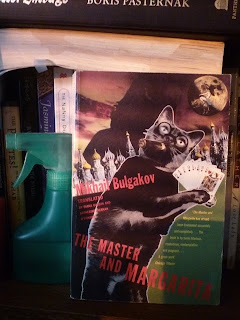
The most formative and weird period of my young adulthood was my four-month-long study abroad term in Glasgow during my junior year of college. My classmates and I were enrolled in English literature courses at the University of Glasgow, and I opted to have my one elective course be yet another literature course instead of something fun, like studio art or Scotch distilling. In short, my study abroad experience was more monk-like than spring break. Glasgow in the fall gets about 5 hours of daylight daily, most of which I spent in the library reading Jacobean revenge dramas and strange books like The Master and Margarita. Among the essay deadlines for my three lit classes, I barely found the time to feed myself, letting myself believe that my roommate’s orange Bacardi Breeze was an acceptable substitute for orange juice at breakfast time. This cracked-out British jacket for The Master and Margarita is a fitting illustration of how my life felt at that time. Best four months of my life!
This book is a stand-in for an intense graphic novel phase I went through senior year of college—coincidentally, the same year that my college introduced a course on graphic novels. We read so many Pantheon titles…and then I graduated, moved to New York City, got a job at Random House, and started working on those titles! DREAMS REALLY DO COME TRUE.
So. Have I come any closer to answering my post’s question? I’m not sure. I suspect I should have read more age-appropriate books. But what I’m really interested in are the books haunting your childhood shelves. Do it up in the comments!
Subscribe to:
Posts (Atom)

 Posts

