Friday, April 1, 2011
The Invention of Lying

Friday, February 25, 2011
What's in a name?
As you may know, Sunday brings us the Academy Awards, and I know at least one [tk]er has seen all ten Best Picture nominees. Embarrassingly, I've only seen three--and yet there are ballots to fill out and contests to win!
In the absence of actual knowledge, I'm resorting to what I do best: playing with words. Using only the ancient art of the anagram (with the help of an online generator), then, let's try to predict what film will win Best Picture.


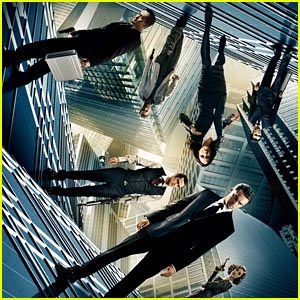

[The] Kids Are All Right: Harried Gals Kilt
It's unlikely, if possible, that the anagram generator expects Annette Bening and Julianne Moore to show up to the Oscars in kilts. No, I suspect this means the "harried gals" and their mostly lackluster (with the exception of Mark Ruffalo) movie will be kilt by the competition.

The King's Speech: Henpecks Eights
The anagram generator predicts--to no one's surprise--that The King's Speech will push aside most contenders--with the exception of one.

The length of this title spelled out broke the anagram generator, exceeding the site's capacity. Let's assume that James Franco's manic energy--and any excess from director Danny Boyle--will similarly confound the Academy.

Well, this bodes poorly for the flannel-robed Jesse Eisenberg. Sorry, Jesse, looks like The Social Network is out, although perhaps you'll win Best Actor for playing "a cloister wonk."

It was always unlikely that Toy Story 3 would win, and the anagram generator throws in another harsh, yet valid, point--as others have pointed out, from what exactly is Toy Story 3's screenplay adapted? That story is untethered, yo.

I disagree with the generator on this, but what can you do? Looks like the Academy will wipe its feet with this one.

Winter's Bone: Newbies Torn
Good try!
The anagram generator is of necessity a bit vague, but I think we can determine a winner here. While it looks to be a close race among Inception, The King's Speech, and The Fighter, Inception is simply not "on top," and The King's Speech only beats eight of its competitors. Let's not forget, either, that The Fighter is a story of hard-won and somewhat unexpected success. Against all odds, The Fighter will win Best Picture.
Don't look at me: it's all in the names.
Friday, January 28, 2011
The Times and the New Social Reader
No one gets between that girl and Mondays.
Well, that’s fine, I thought, it can wait until Friday. Except now Friday is here and, as you’ve probably already guessed, I’ve forgotten the topic that so inspired me. After thinking about it, hard, I thought of something that could have been my great idea—but I’m not sure. The one feeling worse than not remembering a great idea: possibly remembering it, but not having that sense of conviction, not hearing that little snick as it clicks into place.
Anyway, here’s what I was thinking about. I’m currently in a master’s program, and this semester, I’m taking a class on readers and reading. In our first session, our professor had us share our thoughts on that subject—remembering Katie’s beautifully written post from a few months ago, I brought up the question of professionalizing reading (something Jess touched on yesterday as well). That was fine, but a more interesting point was made a few minutes later, when a classmate mentioned the historical shift from communal reading (the family gathered around a father and the fire) to private reading, from the oral to the silent. Now, this woman said, we seem to be swinging back to a more social form of reading with the proliferation of comments, Twitter, and email, with all of the ways of discussing reading material as a group and sharing pieces you find interesting.
The conversation quickly switched topics again, but I stayed with her observation for a while, because it just seemed so true to me. Some of the recent articles in The New York Times on "Why Criticism Matters" also mentioned the socializing effect of internet commentary, where everyone's a critic, but—I thought in class—isn’t the truly strange part how much we share? Looking at the Times’s home page, under “Most Popular,” we find this:
Most E-mailed
Most Blogged
Most Searched
Most Viewed
That, my friends, is peculiar. First of all, it’s peculiar that these forms of sharing (e-mailing, blogging, even searching) are so prominent. When “Most Popular” means “Most E-mailed,” it does not mean “Most Read.” That, one would assume, corresponds to “Most Viewed.” Instead, “Most E-mailed” means those articles readers feel most compelled to give to friends and family. Perhaps unsurprisingly, at this moment, the subjects of those articles are not incredibly serious:
1. Record Level of Stress Found in College Freshmen
2. Nicholas D. Kristof: Tussling Over Jesus
3. Diner's Journal: The Minimalist Chooses 25 of His Favorites
4. Paul Krugman: Their Own Private Europe
5. Personal Health: Long and Short of Calcium and Vitamin D
6. State of the Art: Ins and Outs of Calling via the Net
7. The Great Deflation: In Japan, Young Face Generational Roadblocks
8. Well: How Meditation May Change the Brain
9. Ugandan Who Spoke Up for Gays Is Beaten to Death
10. Skin Deep: Full-Service Gyms Feel a Bit Flabby
“Most E-mailed” is to “Most Popular,” I would contest, as the Thursday Styles section is to the rest of the Times (and in fact you’ll see Styles articles on the list frequently). The articles are a little bit more embarrassing, more about wacky health trends and shocking diet discoveries and, well, the shortcomings of gyms. By contrast, here's "Most Viewed" at the same moment:
2. Paul Krugman: Their Own Private Europe
3. Seizing a Moment, Al Jazeera Galvanizes Arab Frustration
4. A Car Sale Gone Wrong, Then a Grim Discovery
5. David Brooks: Mr. Hamilton and Mr. Burke
6. The Great Deflation: In Japan, Young Face Generational Roadblocks
7. The Minimalist Chooses 25 of His Favorites
8. Court Allows Emanuel on Ballot for Chicago Mayor
9. Ford Shares Tumble as Fourth Quarter Misses Forecast
10. Record Level of Stress Found in College Freshmen
Bu in the publishing world, it’s “Most E-mailed” that matters. When a first serial piece makes it there, we’re delighted. When a particularly smart Sunday magazine article is up, we take notice, and you can bet that writer’s agent will be getting a few calls. But friends: what’s being emailed is not necessarily what’s being read. If that were the case, wouldn’t you expect the two lists to match exactly, or almost exactly? People seem to be reading the news they seek out on their own more than the news that their friends send them. And yet—books don’t work that way, do they? What seems to breed a bestseller is a combination of quality and word of mouth. You need it to be shared.
I’m not sure yet what to make of these thoughts, but it seems to me that the Times’s structuring of their “Most Popular” articles says something about how we should think about buying and selling books in publishing. Americans—or those who are reading the Times, anyway—seem to be interested in the tough topics, although we have to dig a little for that information. So my question is this: how do we make our “Most E-mailed” list look more like the “Most Viewed”? How do we make our readers buy and share the books it seems they just might want to read? How do we make the private reader of the past translate into this new (old) social reader?
Friday, January 21, 2011
In with the New
But when I moved to New York, I had to fit everything I wanted to bring with me in the trunk and backseat of an economy-sized car. My shoe collection was radically downsized. My various college furniture—microwave, mini-fridge, radio—stayed in California. And only the ten books I cared for most came with me. Moby-Dick. Two beloved Austen novels, Persuasion and Northanger Abbey. The books on which I wrote my senior thesis: A Confederacy of Dunces, The Moviegoer, Edisto.
Luckily, one of the first items of furniture we bought in New York was our bookcase. And actually, that was the second bookcase we’d found on Craigslist, and the second that we’d picked up. The difference? This one we paid for, and, more importantly, this one we moved in a car. We’d been less clever with the first, free bookcase, which we thought we’d be able to carry together for thirty-five mostly uphill blocks. We left it on the street no more than a block away from the apartment where we picked it up, and felt terrible about it.
This new bookcase was a monster, though, so even though we had a car, it hung precariously out of the trunk while I clung to it in the backseat. We drove very, very slowly down Broadway, passed by every other car as we cruised along at ten miles an hour.

The bookcase has served us well, but it’s always been a vaguely threatening, somewhat homely presence in our apartment. Gaps show between the shelves and the frame of the bookcase. It’s slightly lopsided. It’s clearly handmade, and wouldn’t match any other bookcase. And, worrying me most of all, we store an enormous, elaborate pot on top of the case. With something this roughhewn and precarious-looking, my constant fear is that it will just collapse one day, leaving the shattered pot amidst the mismatched boards.
The fact is, though, that my initial collection of ten books has grown rapidly since I moved to New York. This bookcase filled quickly, and since then I’ve had to store the extra books I acquire in trades and various book piles in boxes under my desk. It takes up valuable space, and more importantly, it makes these lovely books harder to access. I tried to keep a list of which books were in which box, but it got hopelessly confused at a certain point.
So two weekends ago, when we went through a burst of home improvement enthusiasm, we bought a new bookcase. It’s Ikea, once-removed through Craigslist. This means a) that it was cheap and b) it’s absolutely the wrong color for our living room. It is black, which doesn’t really work with the various other light wood furniture in the room. So we decided to paint it. White. This led to a slight nervous breakdown last weekend, when I realized that the second can of paint I’d bought was a slightly different color than the first (although the label was the same, I swear!) and the freshly painted bookcase sported a distinctly mismatched look.
But the bookcase is finally starting to come together—it just needs one more coat of paint, and then we’ll actually build the thing. So I’ve started to bring books home, box after box. On Wednesday night, I lugged the first (cookbooks!) onto the train. The box was small, but heavy. The train was full. An elderly lady took the only seat left—until her husband gestured to me, and she stood.
“No, no!” I said. I stepped away.
“Yes,” she said.
“That box looks heavy,” said her husband.
Well, I took the seat. And I could swear everyone was looking at me with the disdain I myself felt—I couldn’t believe I’d just deprived an older woman of her seat (and even more, that the young man next to me didn’t offer his).
I think there are about twenty boxes left to go. That’s a lot of guilty train rides to endure. Ultimately, though, it’s exciting to be opening these boxes and discovering books I didn’t remember owning, and to anticipate arranging them on the shelves of the new bookcase. I’ve culled a few, leaving them in my building’s lobby for others to pick up, and it makes me genuinely happy to see them gone the next morning—to know that they’ve found new owners. The old bookcase will be moved to our bedroom, alongside the bedside table, and the books languishing beneath my desk will come home at last.

Friday, January 7, 2011
Technology, History, Writing: Why Does Criticism Matter?
Those Doggoned Amazon Reviewers!—and iPods, and iPads
“There is so much noise and screen clutter, there are so many Amazon reviewers and bloggers clamoring for attention, so many opinions and bitter misspelled rages, so much fawning ungrammatical love spewed into the ether, that the role of the true critic is actually quite simple: to write on a different level, to pay attention to the elements of style.” –Katie Roiphe
“With the advent of Amazon reviews and other rating sites the audience is abundantly vocal. A sensitive membrane has evolved from the historical transactions between author, critic and reader. Though online reviews inevitably vary in quality and insight, their very existence no longer makes it possible to imagine that there is not an engaged general-interest audience out there consuming and thinking about literary works. The audience now talks to itself.” –Stephen Burn
“I tend to shy away from big, sweeping, era-defining statements. It’s the fastest possible way to be wrong about the world, and usually just an excuse for various forms of sloppy thinking: cherry-picking, scapegoating, doomsaying, fear-mongering, sandbagging, arm-twisting, wool-gathering, leg-pulling. And yet it would be hard to dispute that over the last 5 or 10 years, the culture’s relationship to time has changed pretty drastically. The shift is so obvious that it’s boring, by now, even to name the culprits: Google, blogs, texting, tweets, iPhones, Facebook—a little army of tools that have given rise to (and grown out of) radically new habits of attention.” –Sam Anderson
“I think we can say with confidence that in 200 years Anna Karenina and her men will still exist. And the iPad—who knows?” –Katie Roiphe
The History of Histrionics
“Before the requiem begins, we have to admit that critics have always been a grandstanding, depressive and histrionic bunch. They—and by ‘they’ I mean ‘we’—have always decried the decline of standards, the end of reading, the seductions of mediocrity, the abysmal shallowness and distractibility of the general public, the virtually apocalyptic state of literature and culture. Yet somehow the bruised and embattled figures of both the writer and the critic have survived lo these many centuries.” –Katie Roiphe
“What looked to Kazin like a dwindling, fissiparous literary culture looks to us like a golden age. (As yet another great critic, Randall Jarrell, once said, in a golden age people go around complaining about how yellow everything looks.)” –Adam Kirsch
“It helps to remember . . . that every era in the history of humanity has lamented the rise of whatever technology it happened to see the rise of.” –Sam Anderson
Write Well, Accomplish Much
“Now, maybe more than ever, in a cultural desert characterized by the vast, glimmering territory of the Internet, it is important for the critic to write gracefully. If she is going to separate excellent books from those merely posing as excellent, the brilliant from the flashy, the real talent from the hyped—if she is going to ferret out what is lazy and merely fashionable, if she is going to hold writers to the standards they have set for themselves in their best work, if she is going to be the ideal reader and in so doing prove that the ideal reader exists—then the critic has one important function: to write well.” –Katie Roiphe
“Whether I am writing verse or prose, I try to believe that what matters is not exercising influence or force, but writing well—that is, truthfully and beautifully; and that maybe, if you seek truth and beauty, all the rest will be added unto you.” –Adam Kirsch
“We have to work harder to justify our presence on the page, our consumption of readers’ increasingly precious attentional units. This means writing with more energy, more art, more conviction, more excitement and a deeper sense of personal investment.” –Sam Anderson
What Does the Critic Accomplish?
“Stepping aside from the culture of opinion, delving deeper into open-minded analysis, critics might fulfill their most important function: locating major works that are not always visible in mainstream networks.” –Stephen Burn
“The previous decade of severe political and economic shocks may end up opening literary criticism and literature to the questions Kazin and his peers asked of them . . . The line of inquiry that connects a writer to her world runs through quirks of individual personality and literary manner to broaden into larger moral and political issues. The critic who follows this method, staying close to the texture of social history as well as to aesthetic experience, is likely to avoid the intellectual isolation and self-pity of the kind Kazin describes.” –Pankaj Mishra
“A more productive and more faithful (albeit less literal) application of Freud’s theory to literature may be found in Marxist criticism, which searches the work of art for signs not of the writer’s personal sexual history, but of history itself. Literature viewed in this way becomes a gigantic multifarious dream produced by a historical moment. The role of the critic is then less to exhaustively explain any single work than to identify, in a group of works, a reflection of some conditioned aspect of reality . . . Much as there are things about our own life stories that we can learn only from the systematic study of our dreams, there are things about the human condition that we can learn only from a systematic study of literature.” –Elif Batuman
“It’s better—certainly it’s better for the critic—not to see criticism as a means of making things happen, of rewarding and punishing, or of becoming what Kazin calls a ‘force.’ The critic participates in the world of literature not as a lawgiver or a team captain for this or that school of writing, but as a writer, a colleague of the poet and the novelist. Novelists interpret experience through the medium of plot and character, poets through the medium of rhythm and metaphor, and critics through the medium of other texts.” –Adam Kirsch
“If critics can fulfill this single function [to write well], if they can carry the mundane everyday business of literary criticism to the level of art, then they can be ambitious and brash; they can connect books to larger currents in the culture; they can identify movements and waves in fiction; they can provoke discussion; they can carry books back into the middle of conversations at dinner parties.” –Katie Roiphe
“Why, then, do we read? There’s something Buddhist about literary reading, as I understand it—you drop yourself into a little pocket of silence and peace and allow magical things to happen to your consciousness. I read, on the most basic level, because it makes me happy. It calms my brain down. My wife and I sometimes refer to this as ‘textual healing’: if I’m in a wretched mood, feeling oppressed by the world, I can go off with a book for an hour and suddenly be myself again. This practice, if you’re receptive to it, can come to define your life—can come in fact to seem like the very definition of a rich life. (Pound: ‘Man reading should be man intensely alive. The book should be a ball of light in one’s hand.’) If our era needs to learn that lesson, or to relearn it, the book critic is in the best possible position to teach it.” –Sam Anderson
I consider the two first themes listed above—attacking technology and dismissing fears based on history—some of the greater traps of discussing criticism. The first, it seems to me, is just too easy. Those Amazon reviewers, ignorant of the “elements of style,” are sitting ducks. It’s like those popular bestsellers that Jessica mentioned yesterday: mocking them, however gently, isn’t so difficult as attempting to understand—and maybe applaud—them. And of course the iPad won’t be around in two hundred years, but technology will be. To direct your loathing at one device, and to oppose it to books in general, is to present an essentially misleading non-sequitur.
Similarly, to mention hysteria’s historical precedent is, at this point, both annoying and irrelevant. Over the last few years, premonitions of doom and the death of print have been widespread. And the first couple of times (hell, I’ve probably done it here) someone announced the truth that every age decries its own downfall, it was refreshing. But half of the six articles here make the same observation. It has ceased to seem wise or reassuring. At this point, it sounds as much like fear as anything else.
If, for some reason, you can only read one of the six, I’d suggest you go for Anderson’s. Yes, he falls into both traps. But his essay also reminds us that criticism is an art. You have to write well about writing, because to do anything is to invalidate your work. In so doing, what you’ve produced becomes, if not the equal of its subject, its peer. No, Anderson—and the other few who focus specifically on the importance of good writing—doesn’t answer the bigger question: why does art matter? But he does argue, persuasively, that the critic is an artist himself, that he mimics the great achievements of his subject (writing) as well as what it means to be a good reader and a valuer of books: “If our era needs to learn that lesson, or to relearn it, the book critic is in the best possible position to teach it.”
Friday, November 12, 2010
Ralston College: the Future of the Liberal Arts?
After running through some of these arguments (including those of a book on which I worked, Mark Taylor’s Crisis on Campus), and “while [he] was trying, and failing, to make sense of all this,” Fish suggests that maybe, just maybe, higher education has found its savior: Stephen Blackwood, and his still-under-construction Ralston College. The story is this. Ralston is a new undergraduate institution that will be built in Savannah, Georgia. It will insist on a thorough grounding in the liberal arts. Tuition will be paid for all students. And Blackwood, a recent Ph.D. recipient whose background is in religion and classics, will be its first president.
Here’s how Fish describes the academic experience:
“When they get to Savannah, the students of Ralston College will find that the school year is the entire year, 12 months, that they are expected to dine together and wear academic gowns, that they will all be reading the same texts organized around a yearly theme (in successive years, the Self, God, Nature, Community and the Beautiful), that the texts will be ‘supremely difficult’ and begin with Greek and Roman authors, many of whom will be revisited the next year under the aegis of a new theme, and that they will also be receiving instruction in the visual arts, mathematics, the sciences and foreign languages (at least two).”
Ralston does not truly signify a new beginning: the insistence on the primacy of a classical canon is an essential part of the culture wars, and books like Hacker and Dreyfus’s represent just the latest iteration. All universities cope with the pressure of the canon in some way—the University of Chicago’s Common Core curriculum and Columbia’s Core Curriculum are two examples—and so do smaller colleges. St. John’s College, in Annapolis and Santa Fe, demonstrates a similar dedication to the classics through its Great Books Program; Deep Springs College, in the California desert, also emphasizes commitment, seriousness, and intimacy.
But Ralston and Blackwood are making an effort, and they’ve got admirers: “Either blissfully unaware of the obstacles rehearsed in the woe-is-us books or wrapped in the armor of faith and innocence like a modern St. George, Blackwood, without very much experience or money, has so far managed to secure a promise of buildings to house his new enterprise [and] gained the moral and honorific support of Harold Bloom, Hilary Putnam and Salman Rushdie.” (Fish doesn’t mention here that he’s among the official supporters, a member of their Board of Visitors.) In fact, one of the only visible online manifestations of that effort—their Twitter feed, which seems somewhat contradictory to their “Back to the future” approach—is largely dedicated to cataloguing the support and biographies of those admirers. Here’s one series of tweets:
Ralston College is delighted to announce that Sir Salman Rushdie has agreed to become a founding Patron of the College. 3:16 PM Nov 3rd via web
Sir Salman is a Fellow of the Royal Society of Literature and the recipient of many other awards and honors. 3:26 PM Nov 3rd via web
His novel "Midnight's Children" won the Booker-McConnell Prize in 1981 and the James Tait Black Memorial Prize for Fiction. 3:36 PM Nov 3rd via web
It also won the Booker of Bookers award in 1993 and the Best of the Booker award in 2008. 3:54 PM Nov 3rd via web
Sir Salman is a noted defender of civil liberties: he famously declared in December 1991 that "free speech is life itself". 4:25 PM Nov 3rd via web
These words come from an address (which he risked his life to deliver) marking the 200th anniversary of the First Amendment. 4:30 PM Nov 3rd via web
In a Latin translation they are the motto of Ralston College: Sermo Liber Vita Ipsa. 4:35 PM Nov 3rd via web
Ralston College salutes Sir Salman's defence of freedom of thought and expression and intends to emulate him in this respect. 4:38 PM Nov 3rd via web
As I’ve mentioned previously on this blog, my boyfriend and I like to play academically themed games with one another. While Crisis in Campus was still in production, we talked about what an ideal college might look like. We plan classes. We’ve extensively discussed opening a small school in New York that would function much like an arts-based Mountain School (or any other exchange program for high school students). And so, I applaud the effort here, and especially Blackwood’s can-do spirit—so much so that I was even able to stifle my amusement at Ralston’s requirement of gowns, to refrain from asking the question, “But will this be fun?”
Many consider him to be the world’s foremost literary critic. 1:00 PM Sep 27th via web
Instead of working and playing with the demands of a new media form, the Twitter feed, Ralston flatly imposes a traditional format on it. A biography will take shape!—even if it needs to be divided into 140-character chunks. It’s this—well, and maybe the tone of the tweets—that worries me most about Ralston. If they’re this inflexible (and, ultimately, unsuccessful) with something as simple as Twitter, what will the college look like? Although I too believe in the primacy of reading and writing, I'm not sure this is the way to save higher education—or the humanities.
Ralston: I’ve got my eye on you.
Tuesday, October 5, 2010
In Defense of Little, Brown
“I refuse to purchase this book IN ANY FORMAT until the publisher lowers the e-book price. It's time for them to come to terms with the technology.”
“I join in the consumer outrage that a print publisher would charge more for a digital edition than a paper edition. I sense that the conglomerate publishers need to learn a lesson, and having a book or three fail because of consumer backlash is probably the only way to get that message across to them.”
“This is corporate greed on display as the suits in their ivory tower think they can set the price for the digital version of the book anywhere they please and people will buy it just so they can have the e-book reading experience. They think we're too stupid to realize they're price gouging us. I'd like to hear one these publishing executives explain the rationale for this pricing. I'd be very interested in learning how the publishing industry can save us money by not publishing a digital edition.”
“Electronic books are definitely the way of the future, like it or not, and this pricing is how we now know it is true. Commerce has seen the future and it is with us ebook readers. Therefore the higher price, even though it is infinitely cheaper to produce and transport.”
“The publishing companies will not see the next decade unless they come to terms with new technology. Pricing an ebook more than the hardcopy is not the right start.”
Ultimately, of the 31 one-stars, five actually evaluate the quality of the writing. The others are spent complaining about either the ebook/hardcover price gap or about a misleading free sample button that Amazon featured on the book page.
Before addressing the anger these would-be readers feel, and the points they bring up, I have another question to ask. When did Amazon reviews become a legitimate place to rate anything other than the book itself? Dear ranters: other Amazon readers are not looking at the ratings to learn more about your personal politics, your views on the author, or your views on the publisher. In fact, those readers might just have their own opinions on those various subjects, and they’ll hardly need the benefit of your thoughts. No, they’re looking for informed opinions about the book itself, and that’s probably what you should stick to. Any review prefaced with “I haven’t read this book, but” is useless. Write an op-ed or a letter to the publisher instead, as I'm doing right now in response to your reviews.
Anyway, back to the Patterson reviews themselves. After all of this anger, if you click on five-star reviews, you’ll find four reviews that evaluate the quality of the book, and then this lonely little voice:
“Amazon is underselling other booksellers by making almost no profit on each book. It's akin to an insider bank thief skimming pennies from millions of accounts and making a fortune. The problem isn't that the kindle price is too much, it's that the hardcover is being sold for too little.”
Er… what? But what about the CONGLOMERATE PUBLISHERS full of CORPORATE GREED intent on GOUGING CONSUMERS and incapable of COMING TO TERMS WITH THE TECHNOLOGY?
Well, let’s just (tentatively) follow Mr. Five-Star’s suggestion, that maybe there’s a misunderstanding here, and discuss some of the claims both explicitly and implicitly made in the one-star reviews, with that thought in mind.
1) Claim #1: Publishers are setting a higher price for the ebook than the hardcover.
Actually, as the New York Times article points out, there are two separate entities with pricing power here. The first is, yes, the publisher, because in these two cases, they have the ability to set the Kindle price. But the second entity is Amazon, and they’ve set the hardcover price on their website. Amazon’s business model, in case anyone isn’t aware, is to buy large numbers of hardcovers at the wholesaler’s discount and to resell them to consumers at more or less this price. It’s a decision that benefits the consumer but is ultimately in Amazon’s self-interest: as Mr. Five-Star above notes, such discounts mean that Amazon makes a very slight profit on each book but ultimately establishes a monopoly, meaning that those few pennies become a fortune. So in fact, publishers are still setting a lower price for the ebook than their hardcover asking price. It’s Amazon that is undercutting.
2) Claim #2: Ebooks are cheap to produce and should be cheap to buy.
Makes sense. But here’s a rundown of publishers’ costs from “Publish or Perish,” an article by Ken Auletta in The New Yorker: “Traditionally, publishers have sold books to stores, with the wholesale price for hardcovers set at fifty per cent of the cover price. Authors are paid royalties at a rate of about fifteen per cent of the cover price. A simplified version of a publisher’s costs might run as follows. On a new, twenty-six-dollar hardcover, the publisher typically receives thirteen dollars. Authors are paid royalties at a rate of about fifteen per cent of the cover price; this accounts for $3.90. Perhaps $1.80 goes to the costs of paper, printing, and binding, a dollar to marketing, and $1.70 to distribution. The remaining $4.60 must pay for rent, editors, a sales force, and any write-offs of unearned author advances. Bookstores return about thirty-five per cent of the hardcovers they buy, and publishers write off the cost of producing those books. Profit margins are slim.” To summarize: only a very slim portion of the price of a book represents what is spent printing it. The rest goes to the people who are making the book the best it can be: the author and the editor, as well as the publicity, marketing, sales, and art teams. One might argue, with some validity, that many publishing houses today are overstaffed and could be run more efficiently, but that’s ultimately beside the point here. The point to be made is that just because something is digital, it doesn’t mean it’s free or even cheap. The same effort goes into any good book that is published, and these expenses will remain regardless of whether reading goes entirely digital.
3) Claim #3: Ebooks are the wave of the future, and publishers refuse to accommodate that fact.
Actually, publishers recognize this—more than you could know—and are working very hard to change. It’s not easy, as you’d probably guess. Publishing houses, like any company, are made up of a lot of different people with different kinds of knowledge and different vested interests. There are young people, mostly assistants, who are perhaps more knowledgable about technology and more excited for its potential. There are older employees who can’t tell an iPod from an iPad. There are those on either side who don’t fit the mold, including young employees who are entrenched in orthodoxy and older employees who are excited for technology but don’t understand it and those who do. There are those, like me, who are mildly excited for innovation but are ultimately pragmatic, and just see this as the inevitable, mostly unscary next step. What publishers do refuse to accommodate, though, is the belief that what Amazon says is the future is indeed the future. Ebooks, as an employee here said recently, are media’s next frontier, an untamed Wild West. From royalty rates to ebook prices (two points of contention that are ultimately linked, contested between agents/authors and booksellers, with publishing houses in between), it’s a world of brawls and uncertainty, and publishers are trying just as hard as Amazon and Andrew Wylie to figure out what’s right and best for readers—and ourselves—as we push forward.
4) Claim #4: Publishers are greedy—and hate us, the readers.
This is both an explicit and an implicit claim. The reviewers above seem to think that Amazon is on their side and the publishers are out to get them, to squeeze every last drop from them. But this isn’t true. The thing is, the people who work in publishing love books. That’s why we’re here—it’s certainly not a career to go into for the money. And because of that, we also love you, the readers. We’re here to see that what we love, good books, is something that continues into the future, and that those books always get to you. Now, there’s been a lot of talk about the death of print. Sometimes the wild talkers have cast you, the ebook reader—or maybe you, the American non-reader—as some sort of philistine. Either you’re not reading or you’re reading trash. I apologize for that talk now, because when I see ebook sales, I know that it’s not true. When I see soaring ebook sales, sales that put hardcover results to shame, I’m hopeful: because it means you care. It means you want our books. Yes, we want to sell them to you—but we also want to just know you’re reading. A world of readers means a world where our passions are still important and relevant.
There are plenty of other things I could address here—things that I believe in, like the continuing importance of at least a small print run, and of the value of the people who work at publishing houses, especially editors and copyeditors—but this has gone on long enough. Although I’m sad to see Stieg Larsson deposed from the top of the New York Times bestseller list, best of luck to you, James Patterson, and to your devoted readers—solidarity is exactly what we need as we move forward into this brave new world.
Tuesday, September 28, 2010
A Musical Tradition of Storytelling
Recently, however, Jessica flew out to San Francisco and wrote a blog post about the literary culture thriving there. This weekend, I’m headed to San Francisco myself (and for me, this more or less means going home), but it’s not to visit publishing houses or survey the magazine and journal culture there. Still, I’d like to tell myself that it’s something of a literary journey. I’m going to the tenth anniversary of Hardly Strictly Bluegrass, for what promises to be a jet-lagged and intoxicating three days of music.
The first time I went to the festival was in 2005, when I was beginning my junior year of college. It was five years old then, and I mostly went to see Gillian Welch. I remember her performance clearly—or was it the next year’s?—and the moment when she looked out at the foggy meadow in Golden Gate Park and declared it “gothic.” What I don’t remember are any of the other performances, and that’s embarrassing. Looking at the archived schedule now, it’s a knockout: Doc Watson, Earl Scruggs, Joan Baez, Robert Earl Keen, Ralph Stanley, Emmylou Harris, Dolly Parton, Rosanne Cash. Some people I’m excited about—Tim O’Brien—and others my boyfriend is excited about, like Laura Cantrell. (At the time, he was just a friend on whom I had a miserable crush.) Anyway, I’m pretty sure we skipped the second day of the festival and spent the first camped on Gillian Welch’s field for hours and hours, missing some great music, and fine storytelling, along the way.
We went again the next year, this time as a couple, and this time for both days. My sister joined us one day; on another, my boyfriend and I quarrelled, leaving me pouting near the entrance to the meadow while he, wisely, watched a performance by Earl Scruggs. Never again—I hope.
Since then, I’ve learned more about folk music, although I’m still more ignorant than some, and more about concertgoing as well. This weekend, I’ll still gravitate toward bigger names, but this time "bigger names" means not missing out on Doc Watson or Ralph Stanley, both legends. Most of the people who performed in 2005 will be there this weekend, along with some new names—the Carolina Chocolate Drops, Sharon Jones and the Dap-Kings—and some musicians who are indeed “hardly strictly bluegrass,” MC Hammer among them. Patti Smith will be there; so will Elvis Costello; so will Conor Oberst. I’ll try to attend some smaller concerts when I can, mostly in the morning, by bands I haven’t heard of. I won’t bring a blanket, which, to me, only brings frustration as the meadow grows increasingly crowded. I’ll travel light, moving quickly from concert to concert and grabbing five minutes of extra music in the intervals between staggered shows. I’ll look forward to dinners in the Mission at night. I’ll see friends—and it’s funny that friends from college and high school are planning to go independently, signalling just how much the festival has exploded in the last five years (as it had, apparently, in the five years before that)—and hopefully family too, but I won’t let their tastes keep me from seeing the performers I choose.
That’s what I’ve learned about (happy) concertgoing in the last five years. In that time, I’ve seen Welch (and her reversed band with Dave Rawlings, the Dave Rawlings Machine) perform at least five times. I remedied my missed Scruggs show by going to see him in New York. I’ve seen Oberst (with or without the Monsters of Folk) twice; Fountains of Wayne twice; Sarah Lee Guthrie twice; Trombone Shorty once; Baez once; Martin Sexton once; Sharon Jones once. This for someone who had never been to a concert before college—and now I’m flying across the country to see them all again.
Why? Because their concerts are always great. Chances are that this will be my last chance to see Doc Watson, and possibly also Ralph Stanley. This weekend, I’ll hear the stories they have to tell. But with these younger musicians, the concerts themselves become the stories. Like the time we saw Fountains of Wayne in New Jersey, in a crowd composed almost entirely of middle-aged businessmen and prepubescent girls, a crowd that exploded when the band played “Stacy’s Mom.” (One teenager near me: “Finally, a song I know!”) Or when fourteen members of the Guthrie family, if I remember correctly, played the Berkshires on Valentine’s Day weekend. Or when Oberst forgot the lyrics of a song in Berkeley’s Greek Theatre, and his band played to mumbling and then silence for an unbearably long time.
Bluegrass—even when it’s hardly strictly so—is a musical tradition of storytelling. It's music to be shared, and this weekend, it will be, likely with a very large crowd. So this weekend promises to be exhausting, overcrowded, overstimulating . . . and terrifically fun. When I come back from San Francisco, I think I’ll have some stories of my own to share.
Tuesday, August 24, 2010
New York's Literary Failing
(For some reason the Met thought it would be a good idea to release tickets twice a day, in person, at the museum. Dear Met: you are not Shakespeare in the Park. If you have an ongoing exhibit, why not let people reserve their free tickets online for a fixed date in the future? Hm?)
Anyway, so there we were, looking for something to do. We were both in a museum-going mood, so I scoured a list of museums in New York, looking for an exhibit we’d missed or simply a museum we’d never been to. And I put together a few options: the American Folk Art Museum in Midtown; Woodlawn Cemetery in the Bronx (to see Herman Melville’s grave, of course); or the Queens Museum of Art in Corona Park, with a stop in Flushing for Vietnamese food. The last possibility won.
To anyone who hasn’t been, I would recommend a visit to the Queens Museum of Art. First reason, for literature lovers: when it was first constructed, Corona Park replaced the valley of ashes (remember T. J. Eckleburg?) in The Great Gatsby. Another reason, for those of you who grew up in the mid-nineties: you’ll recognize the unisphere near the museum from the final scenes of Men in Black. In addition: the museum is largely a tribute to the World’s Fairs of 1939 and 1964—the building was the New York City pavilion in ’39—and some of the information on the Fairs is amazing. Easily the best thing about the museum, however, is the Panorama.
Behold:

All five boroughs of New York, scaled down to fit inside one large room, with models of every building in the city built before 1992 (including, eerily, the World Trade Center towers). I was able to find my current apartment building, my old one, my boyfriend’s parents’ building, and on, and on. It’s an incredible thing to see. You should go. Now.
But to go back earlier that day: looking at the list of museums in the city, I was struck by how few literary museums there are here. In fact, there’s only one one that comes to mind—the Edgar Allan Poe Cottage in the Bronx—and even then, it pales next to many of the literary museums in the country.
Why is this the case? My boyfriend noted that there are gestures to memorializing the literary all around the city—the plaques, the bars where your favorite poets drank, and the the landscape of the city itself, preserved, as Corona Park’s ashy past was, in its literature. We considered the constant destruction and reinvention that New York passes through, sometimes depriving us of the buildings that might otherwise house these museums. (On this walking tour of Melville’s New York, for example, the best you can do in many cases is to see “how the boarding house in which Herman Melville was born probably looked” or to stare at the place where Melville’s house once stood, at 103 Fourth Avenue.) When apartments and buildings do survive, my boyfriend noted, they’re often occupied by new tenants.
It’s still surprising, though. Compare us to Moscow or St. Petersburg, where it seems that every building in which Pushkin ever took tea has been converted to a museum, and where statues of him dot many street corners. Or even just hold us next to Concord, Massachusetts. While certainly a hotbed of literary production, does it really make sense that Concord should outnumber us four to one in literary museums? (That’s not counting the reconstruction of Thoreau’s cabin at Walden Pond.) Or that Lenox and Pittsfield, in the Berkshires, should boast both Arrowhead (Melville’s house) and the Mount (Edith Wharton’s home), with the Homestead (Emily Dickinson’s house) just a short distance away?
New York has managed to restore some wonderful historical buildings (the Dyckman Farmhouse and the Morris-Jumel Mansion, for example), sustains incredible museums in many different areas, and is one of the most vibrantly literary cities in the world. So why have we failed so spectacularly to unite these three strengths? The Queens Museum of Art’s Panorama preserves the New York of 1992, but what will preserve—beyond their books themselves—the New York of Melville, Walt Whitman, Wharton, F. Scott Fitzgerald, or Ralph Ellison?
Tuesday, August 17, 2010
Pack . . . Your . . . Bags . . .
August can be a slow-moving, lazily and delightfully paced month. Or, as bosses leave town and with the mounting spectre of autumn before us, it can be the time of year when we (and, alas, others) look around our cubicles and realize just how much work remains to be done. The proposals that have been neglected. The editorial comments required on manuscripts. The permissions—oh, the permissions!
In between projects both small and large, I’ve taken a few moments to imagine where I should head next. Alas, I’m afraid today left me somewhat poorly equipped to dream of any exotic locales:
5. The bathroom. I’ll pass Katie’s office. Maybe she’ll have cookies? Cookies? Cookies!
No. No cookies.
4. Back to my cubicle. Passing Katie’s office again. Are there cookies yet?
3. The cafeteria. Time for iced coffee.
2. Back to the bathroom. And Katie’s office. And… nope.
1. The snack machines: screw this. I’m getting Mrs. Field’s.
Tuesday, August 3, 2010
Searching Outside Scandinavia
My boyfriend, who hasn’t read the Larsson books yet, and I were discussing this last night. I had mentioned recommending the Larsson to a friend who had read Henning Mankell’s most recent novel, and told my boyfriend about the Times article.
“So they’re looking for the next Stieg Larsson,” he said.
“Yes.”
“But why does he have to be Scandinavian?”
Why indeed? I laughed, but then suggested, after a moment of thought, that I thought the next Larsson might be Latin American. The exotic locale, the moodiness of the literature, and the rich history of crime and politics—it seemed possible. And that’s when my boyfriend mentioned Roberto Bolaño.
Readers: this idea makes a lot of sense.
Our book club read 2666 last fall, and a few comparisons had been made then. But let’s think about this for a moment. What do the Millennium trilogy and 2666 have in common?
Millennium trilogy
serial killings
a more conspirational context for those killings (Lisbeth Salander vs. the Sapo)
author’s preoccupation with and political statement about violence against women
a main character who is a journalist
an enormous cast of supporting and main characters
divided into somewhat arbitrary parts (where the last two books seem like one long book)
bleak setting (the frozen wastelands of Sweden)
published posthumously, unfinished
2666
serial killings
a more conspirational context for those killings (women enslaved to drug cartels)
author’s preoccupation with and political statement about violence against women
a main character who is a journalist
an enormous cast of supporting and main characters
divided into somewhat arbitrary parts (where the “Part About the Crimes” feels like its own book)
bleak setting (the desert bordering Ciudad Juarez)
published posthumously, unfinished
It seems to me that what the Millennium trilogy offers doesn’t have much to do with its taking place in Sweden—aside from the long passages on coffee, sandwiches, and Ikea furniture. What it does offer might be subject to debate; many would argue that its strongest and most compelling feature is Lisbeth Salander (2666 notably lacks such a strong female character). 2666, on the other hand, is distinctly more literary, significantly more heartbreaking, easily more beautifully written.
But Stieg Larsson and Roberto Bolaño are united by plenty of other things, including everything in the above lists. They were both former journalists and left-wing activists who participated in foreign disputes, Bolaño working for Salvador Allende in Chile and Larsson supporting Eritrean rebels in Ethiopia. In their books, they both work very hard to capture place, even when those places are empty and inhospitable. They both manage to write books that succeed as mysteries while investigating questions of politics, prejudice, and the role of a writer in society. And both intensely evoke specific moods in their books: nervy and methodical in Larsson’s books, sultry and subtle in 2666.
So for those “finished with all three books and pleading for something similar,” I’d suggest not another trip to Iceland, Norway, or Sweden, but one to Mexico—it's a reading experience to move and thrill even the hungriest of Larsson devotees.
Tuesday, July 20, 2010
Games for Book-Lovers
I'm a member of the listserv for c19: The Society of Nineteenth-Century Americanists. It's a new society, one that had its first conference in mid-May. But despite the success of that conference, and despite the fact that the listserv went live immediately following it, the community has seemed dead for the last two months. I had expected discussion and debate on the listserv, but-- nothing.
Nothing, at least, until yesterday.
On Monday morning, Marcia D. Nichols, an assistant professor at the University of Minnesota-Rochester, emailed the group asking for advice. She's teaching a course in the fall on nineteenth-century medicine and literature, and was soliciting suggestions for texts about dissection. Suddenly the listserv exploded. Everyone had ideas, ranging from poetry to fiction to nonfiction, some of it famous, some of it obscure.
I recognized some of the names of the participants-- in particular Wyn Kelley and John Bryant, who are both on the editorial board of Leviathan, the journal of the Melville Society. Others I didn't. Some suggestions were repeated multiple times, the writers perhaps not seeing the earlier responses in their haste-- but collegiality was the dominant mode, with responders seconding books and recommending each other's critical work. Jennifer Greiman, of the University of Albany, suggested The Life of P.T. Barnum, as well as "Benjamin Reiss's amazing study [that] fills out what Barnum omits."
Reiss's response? "Gulp." And some thoughts of his own.
Anyway, this all reminded me of the kinds of games that my boyfriend and I play on occasion. Sometimes we'll design pretend courses and syllabi-- we did this a lot after we both were counselors and TAs at an academic summer camp. At that camp, course descriptions were very general; for two summers, I was a TA for a Twentieth-Century Humanities class. The shape it took was very, very different under the two graduate students who taught it. The first summer, the grad student was writing his dissertation on modernist poetry, so the kids read "The Waste Land" and some Pound-- but there was also a heavy emphasis on ambiguity, media, and the viewer, so they additionally read Henry James's The Ambassadors and Walker Percy's The Moviegoer. The next summer, another grad student was writing on feminism and the grotesque in Southern literature-- so the kids read, among other books, William Faulkner's Absalom, Absalom! and Gertrude Stein.
How would we teach such a course, we asked each other. What books best framed the twentieth century, for us? What if the summer camp (which is turning more and more to science and business classes) made the unlikely choice of a Nineteenth-Century Humanities class? How would we teach that? And near and dear to our hearts, always, has been the thought of a summer Land Art class, a road trip for students from Marfa to the Spiral Jetty to the Lightning Field, and beyond.
The C19 discussion also reminded me of the most recent session of our book club, where the participants alternated weeks assigning short readings to the group. One member chose a series of excerpts on boredom; another the most excessively violent pieces she could find; I looked for meditations on place and loss. What distinguished all of these-- the course planning with my boyfriend, the book club, and the C19 discussion-- is how they illustrated how much is internalized when we read, and how few chances we get to flex that muscle, to demonstrate our knowledge. Even academics are limited in terms of how much literature they actually get to discuss in their work-- unless any of these authors were actually writing a book on medicine and literature, they wouldn't have many chances to dig deep, to remember the strange and wonderful texts that are out there.
That's why we need games for the literary. Such a game shouldn't necessarily show how well-read you are, if being well-read means knowing how to regurgitate authors and titles. It's become too obvious, working in publishing, how that ability is used to mark boundaries and exclude others from a group. The way we talk about books seems to be more mired in general connections between texts, or meant to signify small victories over other people. In the absence of critical writing-- something we do too little of since finishing our English degrees-- we need games that allow us to revisit all of the works we've read, to keep that knowledge alive and crackling, to remember and discover nearly forgotten themes and topics. Even if that topic is dissection.
Any suggestions?
Tuesday, July 13, 2010
T is for Tuesday so dark and so bleak
There are a lot of things you could say about this concert, and a lot of reasons that New Yorkers should go to see her at the end of the week in Town Hall. Merchant’s dancing is completely unexpected, and incredible. She has a surprising number of redneck fans, whose behavior during the concert made me feel like I was among the groundlings at Shakespeare’s Globe. (Okay, not a reason to see her perform, but definitely an observation of the night.) And Merchant acts like everyone’s mom onstage, clearing clutter, chastising the band, asking them how her food was during rehearsal. By the end of the concert, I wasn’t sure if Merchant’s band members have the best jobs in the world or the worst.
And since I also attended the free She & Him concert on Governor’s Island a week ago, I found myself dreaming of an M. Ward/Merchant collaboration. Merchant, who maintains more presence and energy twitching a single hand than Zooey Deschanel does in leaping across the stage, and Ward would be well-suited in their penchant for punishingly long concerts (last night clocked in just under three hours of Merchant and only Merchant).
Anyway, none of these things has much to do with literature. What is relevant to this blog is that Merchant’s set (pre-encore) consisted entirely of songs from her newest album, Leave Your Sleep, which are all children’s poems that she set to music. You can see the full track list here; I thought there were some bland entries, including this e.e. cummings poem. Since, as my boyfriend noted, Merchant mutters most her lyrics, rendering them largely indecipherable, why make them, for the most part, so gentle? Why not pick a few more controversial ones?
Here are the poems (about, not for, children) that I imagine still wouldn’t make the cut.
5) “The Author to Her Book,” Anne Bradstreet
I cast thee by as one unfit for light,
The visage was so irksome in my sight.”
“The doctor put him in the dark of ether.
He lay and puffed his lips out with his breath.
And then -- the watcher at his pulse took fright.
No one believed. They listened at his heart.
Little -- less -- nothing! -- and that ended it.”
1) “The Gashlycrumb Tinies,” Edward Gorey
“A is for Amy who fell down the stairs
B is for Basil assaulted by bears
C is for Clara who wasted away
D is for Desmond thrown out of a sleigh”
Note: Gorey's poem is made much more horrifying by this film.
Enjoy the poems, and happy Tuesday!
Tuesday, July 6, 2010
My Literary Home
Anyway, speaking of possibly being full of the ghosts of unhappy teenagers—when we looked for our new home (a whirlwind tours of approximately fifteen apartments in two weeks), we had dangled in front of us one odd piece of information about one of the last apartments at which we looked (and the one we finally decided to take). It had its original hardwood floors, bedroom windows that looked out into the park, a fairly big kitchen with a sealed dumbwaiter—and hey, Jim Carroll lived there! (Other features of the apartment that we discovered one at a time, and which still left it an improvement over our old place: poor paint and grout jobs, an upstairs neighbor who moves with all the blitheness of a dumptruck, and roaches.)
The broker told us that Jim Carroll grew up in this apartment. In The Basketball Diaries, he expresses some dislike of the apartment and the neighborhood, but—she said—he returned to the owner of this building in recent years and asked to live there again. The apartment he’d grown up in was taken, but another apartment was available, and that was where he died in September.
She showed us the caution-taped front door of his last home.
After we moved in, I asked her to confirm that he lived there while growing up, but she never responded to my email. But I found it strange, strange, that we were getting email addressed to Carroll. Tax forms, even, which I returned to the IRS. Had he in fact died in our apartment? Some searching online turned up the closest approximation to the truth: I believe he lived in the building next door as a youth, lived in our apartment for some chunk of the 80s and 90s, and died in the building next door.
In the last five years or so, I’ve visited a number of literary residences: Arrowhead (Herman Melville, the Berkshires, twice, once by candleight); the Mount (Edith Wharton, also in the Berkshires); the Edgar Allan Poe Cottage (the Bronx); the Homestead (Emily Dickinson, Amherst); Rowan Oak (William Faulkner, Oxford); the Vladimir Nabokov House (Saint Petersburg); the Alexander Pushkin Museum and Memorial Apartment (a rather morbid one, Saint Petersburg); the Jane Austen House Museum (as well as Chawton House, where her brother lived, Chawton); the Keats-Shelley House (Rome). Museums too, including the Jane Austen Centre in Bath and the Tolstoy Museum in Moscow. And there are places that I’ve just seen from the outside—the house where Austen died, in Winchester; the house where Nabokov lived when he was teaching at Stanford; the Ernest Hemingway Home & Museum (this when I was 14, actually, and we didn’t have enough money for admission, Key West); the reconstruction of Nathaniel Hawthorne’s house near Tanglewood; the Jack London Yukon Cabin (Oakland). This fall I’ll hopefully make my first trip to Boston, where I’ll have a full schedule of sights to see in Concord, and I'll hopefully blog about some of these museums in the future.
Now I live in one of these literary homes myself. And when I saw today that one of Carroll’s novels is being published posthumously, it seemed as though my apartment was home to unseen commerce, as though a ghostly manuscript had made its way from one of our desks to the publisher, and I was just hearing about it now. It was thrilling and a little unsettling—the price one pays, I suppose, for the story behind your shelter.
Tuesday, June 29, 2010
Picture Puzzle Tuesday
THIS IS MARK TWAIN

If you’re not reading it already (and the chances of that seem almost as slim as those that you’re reading this), you should be checking out the University of California Press Blog’s “This is Mark Twain” feature. As I mentioned in my May review, a number of publishers are rolling out books this year to commemorate the 100th anniversary of the author’s death, but perhaps unmatched are the efforts of the UC Press. The jewel in the crown, as I see it, will be published this fall: the first of the three volumes of Twain’s autobiography, which he stipulated not be released until this year.
Anyway, in “This is Mark Twain,” the Press has been posting photos of Twain at work and at play, as well as images of his letters and other written work.
They’ve provided delightful photos such as this one:
And this:
Check it out.
TO KILL A MOCKINGBIRD

The classic novel is approaching its 50th birthday (on July 11th). Events are planned, and several articles have come out about the book and its famously reclusive author in recent days. Here’s a blog post from Publishers Weekly about the publishing phenomenon the book represented:
“A first novel, a coming-of-age story set in the South. The author is utterly unknown, has no academic or media affiliations, no Web site, no blog, no Facebook page, no Twitter account. She is shy. What's a publisher and a publicist to do?
“In this case, the publisher is J.B. Lippincott. There's no record of the publicist. The novel is To Kill a Mockingbird. The author: Harper Lee. And 50 years ago the answer was: not much.”
And here’s the (exceedingly brief) interview with Lee and attending article from the Daily Mail, which has already made the internet rounds:
“Thank you so much . . . You are most kind. We’re just going to feed the ducks but call me the next time you are here. We have a lot of history here. You will enjoy it.”Finally, I’m going to share my favorite (and some of the opening) lines from the book—a book given to me by my grandmother, a book that may represent the first ‘real’ novel that I remember committing to, a book that led to a movie that ignited my seventh-grade crush on Gregory Peck. Here they are:
“Maycomb was an old town, but it was a tired old town when I first knew it. In rainy weather the streets turned to red slop; grass grew on sidewalks, the courthouse sagged in the square. Somehow, it was hotter then: a black dog suffered on a summer's day; bony mules hitched to Hoover carts flicked flies in the sweltering shade of the live oaks on the square. Men's stiff collars wilted by nine in the morning. Ladies bathed before noon, after their three-o'clock naps, and by nightfall were like soft teacakes with frostings of sweat and sweet talcum.”
HAPPY BIRTHDAY, ANTOINE DE SAINT-EXUPERY!

I don’t count myself among the book’s fans, but happy 110th birthday to the author of Le Petit Prince!
Did you figure out the theme? Yes, it’s big hair! Or, um, collars.

 Posts


